Choosing the Best Independent Prescribing University for Pharmacists
Learn how pharmacists can select the right independent prescribing programme, align with NHS priorities, secure funding, and complete supervised practice efficiently.
By 2026, all newly registered pharmacists must be listed as Independent Prescribers (IP). For current professionals, securing this qualification early is critical for career progression and patient care (Stretch, 2023). In Scotland, nearly 50% of pharmacists are IP-qualified, compared with one-third nationally, highlighting regional disparities and the need for timely enrolment (NHS Education for Scotland, 2023).
This guide provides a data-driven framework for selecting the right university, maximising completion speed, and avoiding common pitfalls.
Why Independent Prescribing Qualification Matters
National Uptake and Career Impact
Scotland: ~50% of pharmacists are IP-qualified.
National average: ~33% (NHS Education for Scotland, 2023).
Impact: Early qualification opens advanced prescribing roles and leadership opportunities.
Benefits to NHS Services
Access: Improves timely access to medicines.
GP Support: Reduces pressure on general practice (DHSC/NHS, 2022).
Capacity: Strengthens workforce capacity for primary care.
Funding Status and Eligibility
Funding directly influences access, timelines, and feasibility.
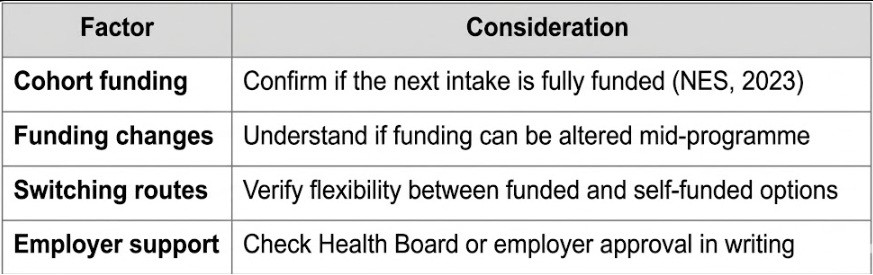
"Many qualified pharmacists reported they were not using the qualification in practice - highlighting a gap between qualification and practical use" (Pharmaceutical Journal, 2022).
💡 Pro Tip: Prioritise programmes with guaranteed funding to avoid delayed completion.
Delivery Model and Supervisory Compatibility
Universities typically offer:
Fully remote learning
Blended learning
In-person clinical skills blocks
Ensure alignment with your Designated Prescribing Practitioner (DPP):
Can the DPP provide direct observation as required?
Does remote learning preserve clinical supervision via digital tools?
Do in-person blocks fit shift schedules and service duties?
"Remote and hybrid delivery increases access and flexibility, but courses must ensure competence through direct observation" (GPhC, 2023).
💡 Pro Tip: Misalignment between delivery and supervision is the leading cause of delayed completion.
Assessment Methodology
Assessment varies by programme. Typical formats include:
OSCEs: Test applied clinical skills.
Observations: Directly observed prescribing episodes.
Reflections: Structured reflective portfolios.
Logs: Competence-based prescribing logs validated by the DPP.
"OSCEs and workplace-based assessment are complementary… portfolios demonstrate longitudinal competence" (GPhC/NES, 2023).
💡 Pro Tip: Choose assessment types that match your learning style to maximise success.
DPP Requirements and Supervised Practice
Direct observation is critical for GPhC compliance:
Minimum 25–40 hours of direct supervision (NES/GPhC, 2023).
Evidence of observed patient consultations, not just shadowing.
Verification that the DPP has the required scope and availability.
💡 Pro Tip: Verify DPP capacity before enrolment - this is a common completion barrier.
Cohort Timing and Availability
Check university intake months (Jan, Apr, Sep, or monthly).
Align with funding cycles and NHS workload peaks.
Confirm consistent DPP availability throughout the programme.
💡 Pro Tip: Poor timing can delay completion by six months or more.
Alignment With NHS Workforce Priorities
Selecting programmes that align with NHS needs ensures long-term career relevance:
IP pharmacists improve timely access to medicines and relieve GP pressure (DHSC/NHS, 2022).
Safe, effective prescribing is emphasised in GPhC guidance (Rudkin, 2022).
💡 Pro Tip: Don’t choose programmes purely for convenience - consider service alignment.
Essential Pre-Application Checklist
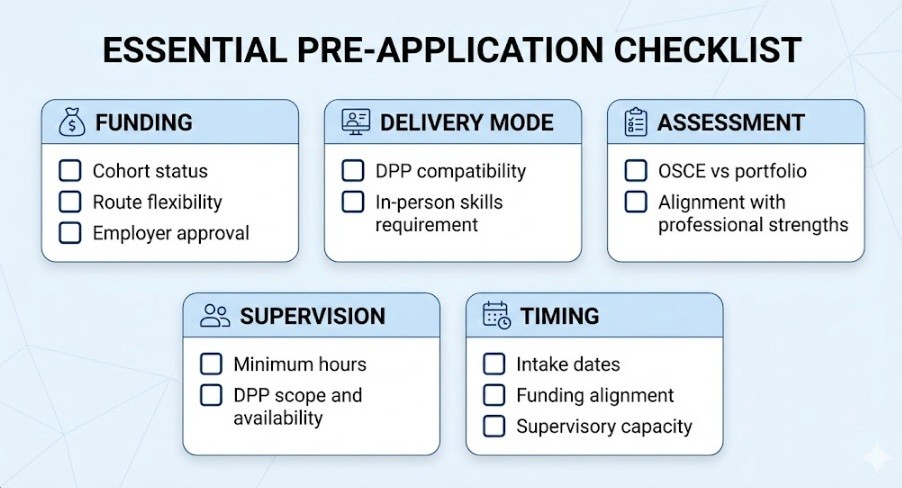
"Most pharmacists fail due to logistical barriers, not academic difficulty" (Pharmaceutical Journal, 2022).
References
Department of Health and Social Care / NHS, 2022. Joint Statements on Access Recovery.
General Pharmaceutical Council, 2023. Independent Prescribing Standards.
GPhC/NES, 2023. Educational Guidance on Independent Prescribing Assessment.
NHS Education for Scotland, 2023. Workforce Development Reports: Independent Prescribing Training Expansion.
Pharmaceutical Journal, 2022. Workforce Utilisation Analysis.
Rudkin, D., 2022. Ensuring Safe, Effective Prescribing Practice. General Pharmaceutical Council.
Stretch, G., 2023. Primary Care Pharmacy Association Commentary on Independent Prescribing.
---
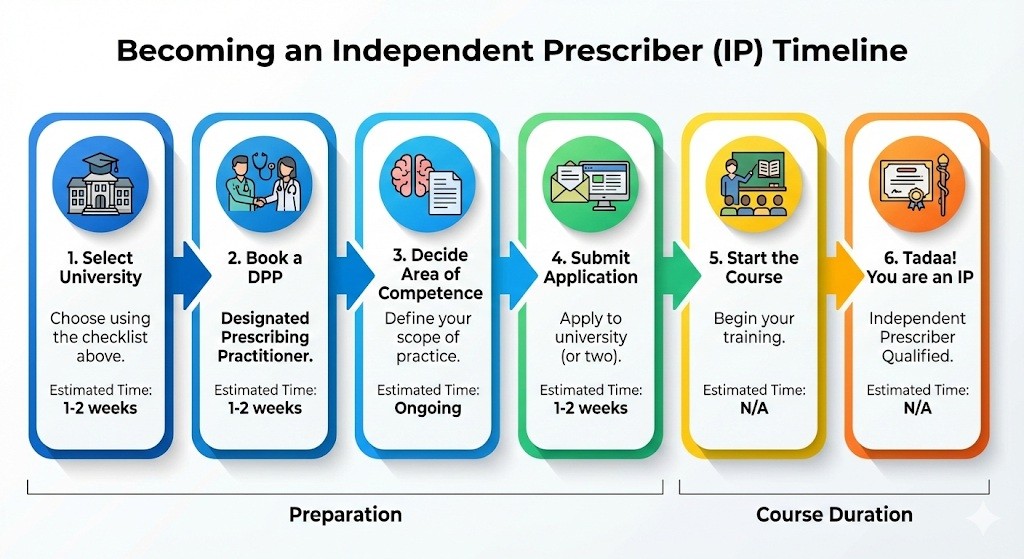
Becoming an Independent Prescriber (IP) Timeline
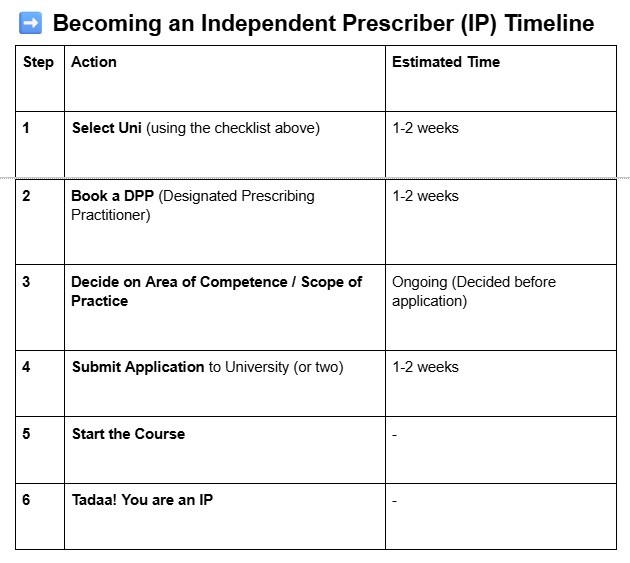
Timeline Diagram: